

Transcript
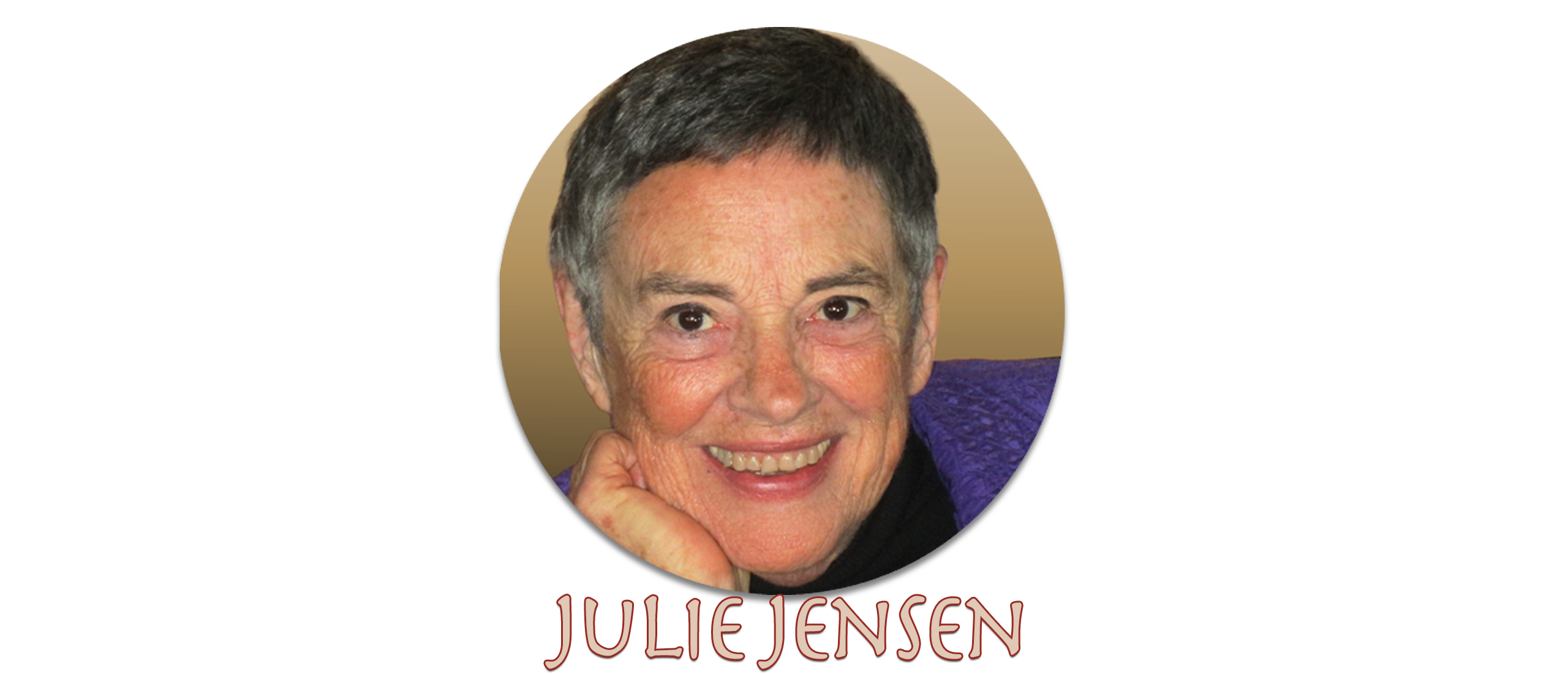
Julie: Our special guest today is someone I’ve known for quite some time, admired for part of that time at least, Julie Jensen. Julie has written over 30 plays, a dozen of them published, all of them produced professionally, several articles in books about the craft. She has a book on the craft called Playwriting Brief and Brilliant, and she’s here to tell us from a vast amount of experience and longevity how it is she does what she does. Welcome, Julie.
Julie: Hi, Julie. Thanks. It’s good to be here. Thank you for inviting me.
Julie: Now, Julie, you know that this series is about the craft of writing how you do what you do.
Julie: Yes, yes, I heard about that. Yeah, it’s a good idea, by the way.
Julie: Well, we’re interested, Julie, in how you do what you do. What is an ordinary, normal writing day like for you?
Julie: About five years ago, I developed a very difficult case of macular degeneration, which means that my eyesight is bad. And while I can read sometimes with torment and torture and many devices, I don’t like to, it’s very hard. So I’m composing differently than I used to. Now I practice all week long a short scene from the play. And then when my assistant comes, she takes it down. I kind of perform it for her and she takes it down. So that’s how writing works for me now.
Julie: Let me ask you this. If you look back on your life as a playwright and you were telling yourself what to do or here’s some advice to your younger self, what would you tell yourself to do?
Julie: Probably tell myself to be a better marketer.
Julie: How would you articulate the influences you had to make you the writer you are?
Julie: I grew up in Beaver, Utah. They are my people. I’m from a long line of them. You know all the people. You know everything about them in a strange, almost pathological way. You know too much about them. But they comprise my catalog of experience. And when I knew I was going to be a writer, which was fairly early, I didn’t really write. I listened. I paid attention. That doesn’t mean I stayed there.
I didn’t.
Julie: Thank you, Julie. Is there a way of tracing your influences? Can you talk about the playwrights you found interesting or really important to you?
Julie: The playwright Sam Shepard. Well, this is his first play. First one I know of. It’s called The Tooth of Crime. And it’s a play about two musicians who are rock musicians. And one is the up and coming one and the other one is the old guy. And there is at some point a war between the two of them. And it’s audacious. It’s weird. It’s Sam Shepard going nuts and not even knowing what he’s doing. And they’re making some sense of it. It’s fabulous. It’s surprising. The other wonderful company that I always loved, Spalding Gray, who’s a writer, and Elizabeth LeCompte are two really experimental people. They specialized in doing plays from the American classical canon. They got in trouble for doing Beckett because what they did is revisit them in most astonishing ways.
And I’ll just tell you a little example because otherwise I’d go on forever. This is a view of their Long Day’s Journey into Night. And there’s a little model of a house that’s about five or six feet tall. And the character who is playing the mother, of course, she is addicted to drugs and the rest of them are addicted to alcohol. I don’t know which is worst. Anyway, she’s a loose canon in any production of this play. And this woman is swinging from the rafters in this model house. And a big wind is blowing her on the side of the stage. And there’s a couple of nuns trying to step on her dress and keep her in place. It’s wondrously funny and deeply profound. I also liked Mabu Meinz, particularly the work of Franz Kreutz, as directed by Joanne Echolitis. These are all weird, weird, weird experimental theatres. And the reason I liked them was that it made theater not just two people sitting on two chairs telling you they hate each other. No, it’s beautiful to watch. It’s gorgeous. It’s stunning, surprising, electric. So those are my faves. Let me see if I told you everything. Yeah, I think I did. Yeah.
Julie: Thank you very much, Julie. That’s inspiring. I wish we could see them now.
Julie: Yeah, so do I. I do.
Julie: Now then, your body of work is strangely varied. And I’d like to just ask you about that. If you think of most playwrights, well, you mentioned O’Neill, actually. O’Neill is one of them that comes out of the gate every time different. But most writers are pretty consistent with their style. You always know who Tennessee Williams play and what it’s going to do and what’s going to sound like. Miller, probably a little bit less.
Julie: Yeah.
Julie: So what accounts for the variety in your work? Could you talk about that, please?
Julie: Thanks. Thanks for asking. Okay. Sometimes I think I want to go in another place in another time and be there for a long while. I want to see something I haven’t seen. I want to write a play that hasn’t been written, whatever it is, hasn’t been said. And then sometimes there are plays about people I kind of know, a combination of people I know. I don’t take anybody’s life and do it or tell the story of my aunt or something. Philip Roth used to write all the time about his family and people he was sleeping with. And he said, well, I’m a writer. Of course they know that. That’s the risk they have knowing me. And it was true. It was a risk with him. I don’t think of myself as being risky, but I certainly use my experiences. And sometimes they’re from Utah, almost always they’re from Utah, but they’re recombined with elements. I lived in New York, Northern California, Detroit, South Bend, Indiana, Los Angeles, Hollywood, and Las Vegas and Salt Lake. So I lived seven places and sometimes I borrow from them too. Is that a good enough answer?
Julie: That’s a lovely answer. I didn’t know all that about you. These interviews I tell you, they’re astounding. And you’ve known people for all your life sometimes. And you simply don’t know the answers to all the questions. Thank you very much, Julie. It’s really been a pleasure. I look forward to seeing your next play. I really admired you for years.
You’ve been listening to Calling the Muse, a series of interviews with Utah playwrights. I’m Julie Jensen, your host, and the audio engineer is Rod Daynes. Thank you.