

Transcript
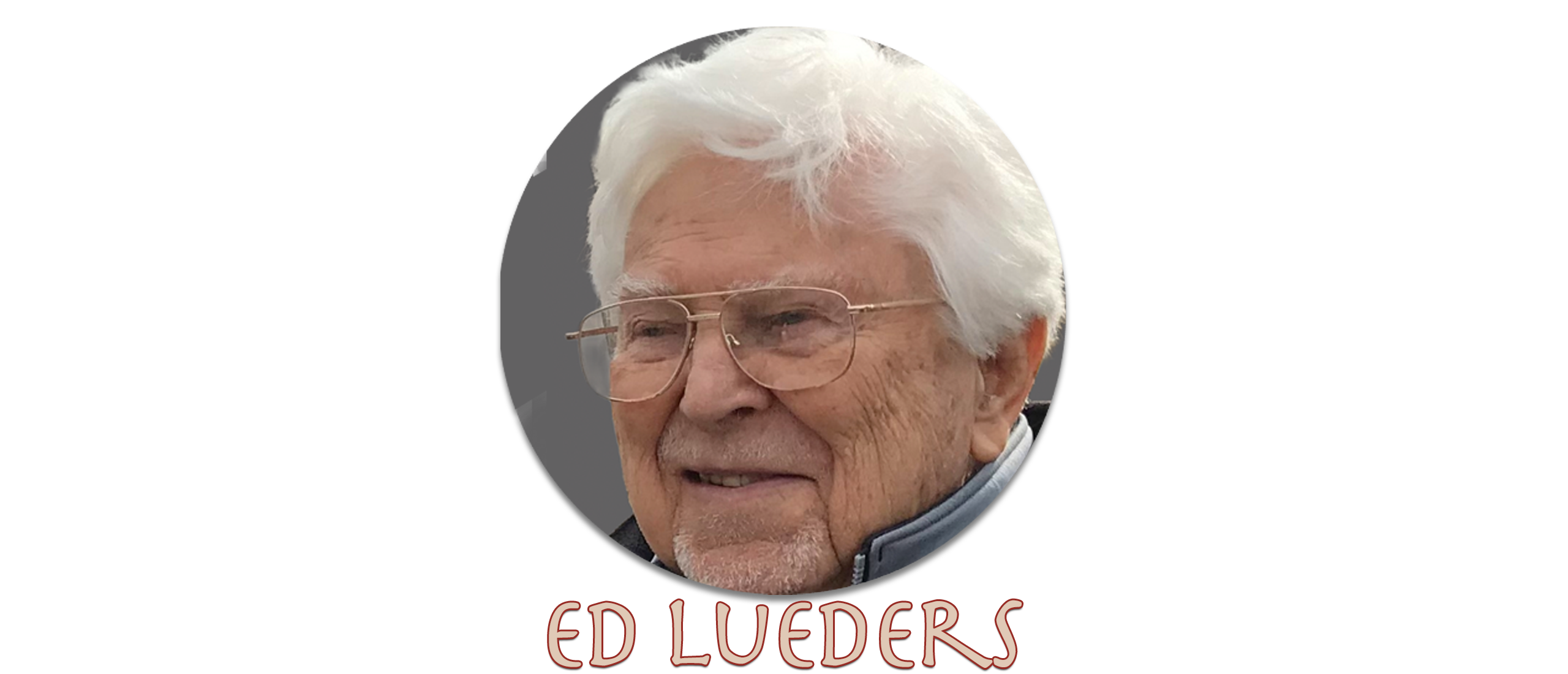
Julie: Today’s guest is Ed Leaders, writer, musician, critic, theorist, poet, translator, an amazing man. He manages to inspire us all, not only with what he has done, but what he continues to do. Thank you very much for being here.
Ed: It’s my pleasure.
Julie: Talk to me a little bit about what a typical day for you is. How does a typical day work for you?
Ed: I have to say, first of all, that I’m legally blind. My hearing is sometimes questionable. I operate with hearing aids. Without them, or if they malfunction, or if I hadn’t charged them enough the night before (chuckles), it’s anything but routine. And macular degeneration, which has been going on for about 60 years, enough so that I refer to myself as a macular degenerate. It affects everything I do. I’ve lost my ability to focus, which means I don’t see what I look at. What I see, I see with what’s left of my peripheral vision, which is fairly good, considering my age of over 100. I can’t write anymore. I must be read to. I have a reading machine. I also get books from the Blind Library, Utah’s state library. Usually, if I have a title of a book in mind, I call them and they will send it to me on a tape, and I have the machine to play the tape and listen to it. Books take a long time, and I tend to nod off from time to time.
Julie: When you look back at your career, your life, your very long and work-filled life, what are you the proudest of?
Ed: If I single out something, it would be the contact I’ve had with such wonderful students. It’s my role as a professor of English, which means that what I do when people ask me, what did you teach? I taught reading and writing. And in the process, whatever level, all the way up and through graduate students, my students were teaching me. I fancy that I was more often their editor rather than their teacher. The motive was to get them writing and have them have the experience and have the results of the experience as good for a reader as possible.
Julie: Did you feel as if you were taught by your students?
Ed: I suppose so. I kept learning how to be a better teacher, and I don’t think I ever got there, because there’s an ideal that’s very hard to do on a day-to-day basis and over a semester basis and put it on a time scale and have numerous students at the same time dealing with the same material, whether it’s what they’re writing or what we’ve been reading. And so far, I’ve not said anything about teaching literature, which is what I was being paid to do most of the time. And the writing courses were, well, they weren’t as large, they weren’t as broadly subscribed. They were people thinking in a specialty fashion about this part of their formal education. Teaching literature is another matter, because that was a matter of discussion in those terms, in those periods when we were teaching through literary writing. I was learning from my students as much as the other way around.
Julie: By the way, I don’t know of any really good teacher that doesn’t answer in a similar way and that their lives were enriched by their relationship with students.
Ed: I would make special friends, but I never wanted to have special students. Every student would have to be special. So, I did a lot of out-of-class teaching when we’d be one-to-one and working as friends. But give and take. In the classroom, there’s more giving on my part than taking.
Julie: Can you identify how you were influenced by literary works, by a mentor or mentors? How did you come to be who you are and who influenced that?
Ed: I can’t single out any people or any person. I learned from such a cross-section of models, as well as formally through teachers. And so, whatever I was reading was teaching me, giving me models of interpretation and of understanding. I was reaching when I was reading. And that’s one reason that I fall back into my sorry situation now where I’m being read to and those things do not apply.
Julie: Sometimes you even get the writer herself or himself. And sometimes that’s helpful and sometimes it’s not.
Ed: That’s right. I want them to talk back to me so that I’m able to talk back to him or her.
Julie: Of the considerable volume of detail in your biography, what are you proudest of?
Ed: I’ve published or had a hand in publishing 13, perhaps 14 books, one of which was more a pamphlet. What I’m most proud of is those that I was the only one responsible. That would be the Clam Lake Papers. The whole book is a metaphor for creative thinking and writing as a consequence. I posed myself for the reader as the editor of the Clam Lake Papers. And I proposed that it was written by somebody else actually was my alter ego. That book I have had such broad and rewarding returns from people who have read it. It has turned into a kind of bedside item for a good many of them and who are glad to tell me that’s been a book in their lives that they don’t want to give up for a moment. The second would be a novel I wrote based on the experiences I had as a GI in World War II. They’re exotic enough to make a story that is full of color as well as being accurate to my own experiences. I didn’t want to write an autobiography of the war. There were plenty of those. The war I was a part of was in China and Burma and India. The CBI theater in which the role I was attached to was with the flying of materials from bases in India to China to assist the Chinese Nationalist Army in our mutual fight against the Japanese. The Japanese making incursions right on China itself and then in Burma where we were beginning to fighting actual war. But I was a non-competant and non-competent I said by mistake but that’s probably true. I was in the bucket seats in flights over the lower Himalayan mountains to a receiving airstrip in Kunming, China and from there by truck and further flight into places where they would be used by the Chinese.
Julie: And you were doing what?
Ed: I was a member of a jazz trio. I played not only pianos which were rare to come by and I had along with me a metal clarinet. I played on the same reed for months and anybody who plays a reed instrument knows what I was in for. And I had a cornet and I loved to play the cornet so I played that as well as the clarinet and if there was any kind of a keyboard I would try to play keyboard as well but they were hard to come by and when I did find them they were in awful shape as you can imagine.
Julie: And so you really were in the special services?
Ed: I was a musician looking after the morale of our troops, the poor guys who were starved for entertainment. The popular songs that we played and the jazz pieces that we played were reminders of home and we just made them feel that what they were doing was worthwhile and they were protecting something worth protecting and all of those sound like the kind of cheesy morale business but when it was the real thing we were doing it was well worth it.
Julie: Thank you. There is an interesting part of your biography which involves translation. I’d like to ask you how you did it but also Japanese?
Ed: The Department of the Army wanted to have a lot to do with Okinawa. The development of Okinawa which did become an American base of considerable size and importance and among the Department of the Army’s objects to have people to work who are native there they sent to the United States for further education. Some of the Okinawans who were prominently placed although they need further training in the language they could continue educations towards a degree in the United States. Now where would they send them? Well, in the infinite wisdom of the US Army mind they thought well let’s see. New Mexico has people which have other languages right? All that Mexican Spanish stuff down there, and that must be a good place for them (they both laugh). So they sent this contention of some 20 Okinawans, one woman and the rest all men. Of course, at the University of New Mexico. they had no idea what to do with them and they found that this graduate student working on his PhD and a teaching fellow had been in India and who knows where and he probably would be more sympathetic or a better teacher and we wouldn’t have to spend any of our regular faculty on these people that are being given us. Well. That’s the long way and a kind of amusing story that leads me to my relationship with Koriama-san who was himself a poet in Japanese better off in his English than most of the other students and he and I became close and I was getting in my PhD and he was kind of getting my PhD along with me and I was using his expertise and experience as a poet in faraway Japan to kind of start my own career as a poet. It was a strange union which eventually when he went back to Japan led to his sending me his translations into English of his favorite contemporary Japanese poets. Koriama-san and I became fast friends and also correspondents across the Pacific with his sending me his translations and asking me as his lifetime teacher, which what do you become with the Japanese, you know, would you help me with these and make them into better English poems which I started doing and having a good time doing it. I did know him well enough and trust him well so that we made a partnership translating these poems which were some of them, very few of them written during the war from the Japanese point of view, but most of them after the war which is when we were working on them as contemporary post-war Japanese poetry. And we kept doing this because he kept sending them to me. And then we started getting together, and I went back to Japan to work with him in Tokyo. I went there three times to work with him and he came to Salt Lake City where I was living so we could work elbow-to-elbow so to speak on these poets that he knew firsthand and I knew only through his kind of basic English translations of their current work. I learned a lot about English translating his English into our English. Anyway, we did that for 10 years as a kind of pastime. Then we grew serious along the way and thought we’ve got what ought to be a book and Copper Canyon Press agreed and let’s see in 1980 something we published a book which was our translations.
Julie: Beautiful.
Ed: It’s difficult but you have to have a lot of faith and a wide imagination. I can’t possibly catalog what I learned in the process. It’s like tuning a piano.
Julie: Great metaphor for it.
Ed: You know you won’t get it perfectly tuned but sound a lot better than it was when you started tuning. Well I was a musician as I was saying earlier during the war. It tended at times to be a kind of embarrassment. What were you doing in the war daddy? Well I played an old clarinet with a broken reed and I told stories about the jazz people I knew. Was a friend to the people who were at the extremity of our services during World War II in Asia.
Julie: You took off from Illinois and somehow landed in the West. To what extent does that matter to you? Is that important to your work? Is it important to your identity?
Ed: Mostly yes but spending all that time in an alien country which was the war against the Japanese, right? And that’s where we were and that’s why we were there. I learned a great deal about being American.
(Interlude. Ed plays a few bars of “Skylark,” by Hoagy Carmichael.)
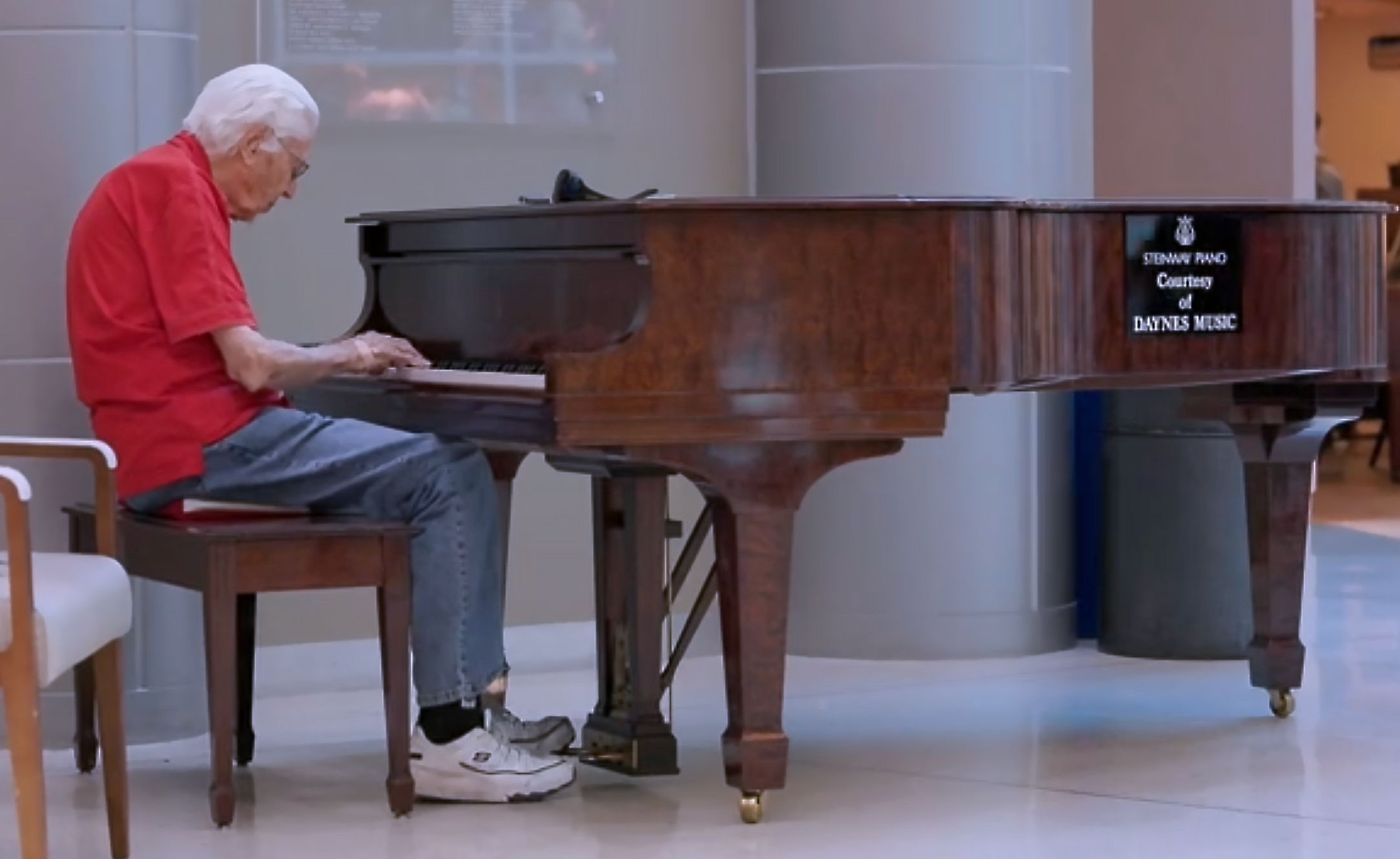
I’m a self-taught jazz pianist and learned from all the jazz greats how to take a tune and play it straight and then to play it the way I play it and that’s what I’ve been doing at the university hospital now for over 10 years. On that piano that is one of the best in the city. And I’ve come to think of it as my piano (chuckles), because I play four hours a week on it. I found my way through a lot of my repertoire on that sheet of paper I have that has some 500 titles. I keep thinking of new ones that aren’t there.
Julie: I have just one last question and this is personal and maybe you don’t want to even answer it. When you’re alone by yourself without otherwise anything pressing, what does your brain talk to you about? What is it you hear?
Ed: These days particularly I try to forget what’s going on in the at large and in our country. My longevity gives me perspective on a whole lot of American history and American character and American potential as well and I’ve been a lifelong student of my country. I think I mentioned earlier that it became almost an obsession for me when I was able to take advantage of the GI Bill to further my education all the way through a PhD. I was the first person to go through a new program called American Studies which had been formulated first at Harvard as American Civilization. And the trick was to integrate not just literature and history which would be basic but all of the other the fine arts, sociology. I had courses in American philosophy. Most people didn’t realize there would be such a such a thing as a college curriculum. And these were integrated by a faculty committee that oversaw my work and chairman in the English department who was sensitive to setting up such a program for graduate students, and I became the first one through at the University of New Mexico. Now it’s established countrywide. Nowadays of course I went when I don’t do much but listen to the radio and television and don’t have much to contribute myself by way of language other than something like this that comes by. I’ve morphed into a musician of sorts by the piano and these are all private and what do I do you wanted to know? I try not to be too aware of the way the country seems to be going wrong and I recognize the part of the whole world in these days in these decades in which we’re not isolated. We’re doing what’s being done everywhere as reactions to one thing or another and the historical story I’d leave to the professional historians except that I’m aware of having been there.
Julie: It’s true that you’ve lived not half of the American experience but almost.
Ed: Yeah. What I do mostly is musing. And I like to think of musing being in the middle of amusement.
Julie: (Laughs.) Oh you’re good!
Ed: Together with a reference to the classical muses of course.
Julie: (Laughs.) Yes, those lovely girls, yes. Thanks so much. You are a delight. I might have to come back and do it again. This is great. Thank you so much.
Ed: Thank you. It’s been a privilege to join you.
Julie: And that was our friend Ed Leaders. And this is Calling the Muse, a series of interviews with Utah artists focusing not on what they have done but on how they do what they do. I am your host Julie Jensen. My audio engineer is Rod Daynes. This recording was made in the fall of 2024.