

Transcript
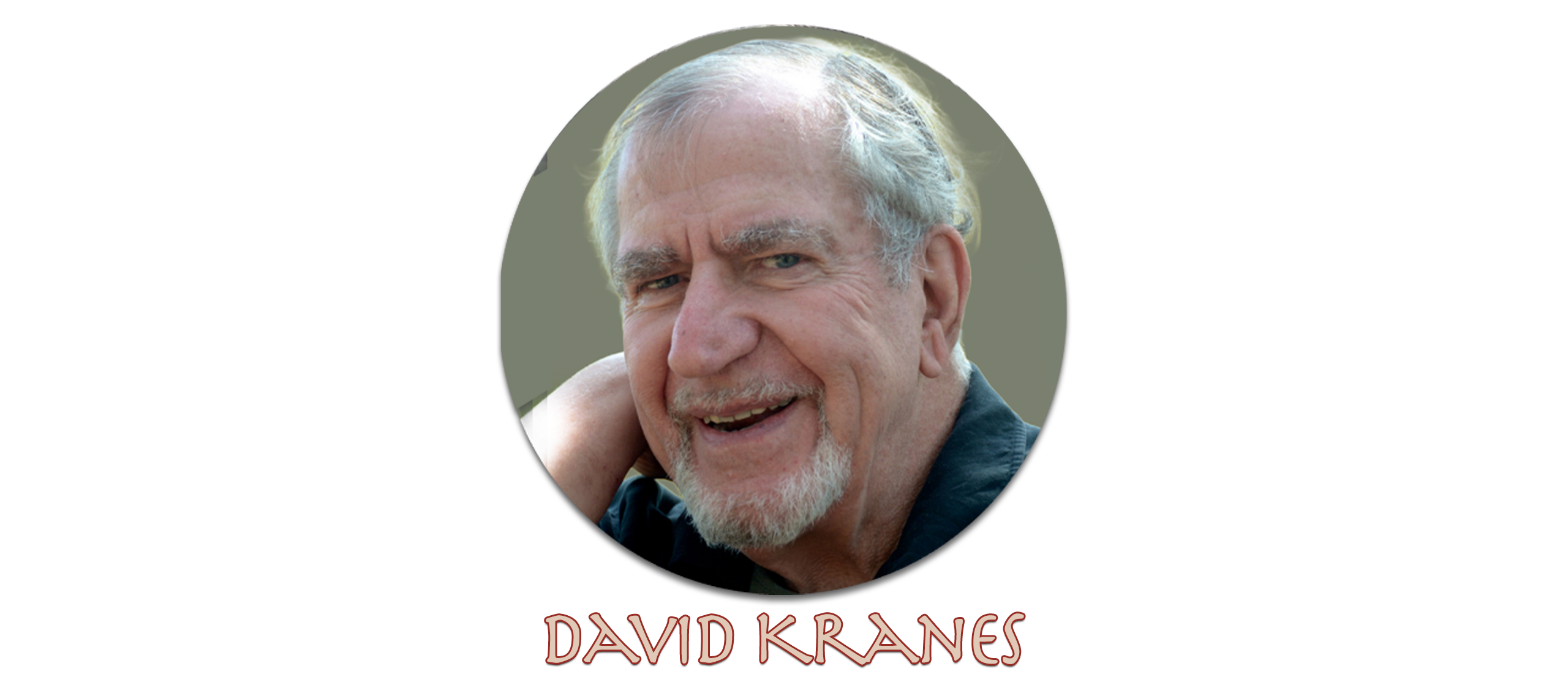
Julie: We have a special guest today, David Kranes, one of the greatest writers in America, author of seven novels, three volumes of short stories, and a playwright who has had 40 professional productions, plus a film. This interview, unlike others, perhaps, is focused on how he does what he does, rather than what he has done. I am interested always in how people make their most remarkable art, and it seems to be a subject that we haven’t covered enough. So, David, welcome, and I’m so gratified to be able to talk to you today.
David: Thank you, Julie. I feel honored that you would choose me as one of your interviewees.
Julie: You’re at the top of the list, alright? And that you happen to live in Utah, have spent much of your life here, and have indeed written about it.
David: Well, I first came here from the East, from Connecticut, and upbringing in Massachusetts. I found myself writing a lot about characters who moved, literally moved, from East to West. And then there was a period where the characters were confused about where they were, or how they should respond to where they were. And then there was the Westerner remembering certain moments in his life. I’m just mentioning that because it ties into your talking about Utah being lucky to have me. I just feel that it’s something that happened.
Julie: If I accompanied you on a day, a writing day, when would it start? Do you have to have some special food, drink? Do you have to think long and then work? How do you do it?
David: What I do is what my friend Ron Carlson, the writer Ron Carlson, said about himself, and that is, you make an appointment with yourself and you keep it. In the olden days, before I was “olden,” I would get up maybe five o’clock and start to write. The University was very, very good to me. They asked me when they hired me, when did I write? And I said, mornings. And so they gave me an all afternoon class schedule, which was, I thought, very graceful of them to do that. So, I write mornings. And then occasionally if something is hot and it’s really just not going away, if it’s nagging at you, then I will try to write straight through the morning and into the afternoon if I didn’t have a class, which is not to say that I’ve disregarded the classes that I taught. Mentoring has been extremely important to me. And I think it’s been important to my writing because you receive an energy from those that you teach that you wouldn’t receive just going for a walk or having a conversation.
Julie: That is beautifully said. Thank you. I was going to ask you a question like that, how teaching it affected your work. It’s not a part of your writing, but it is a part of your head.
David: Yes, definitely.
Julie: If you can go to the time when you mentioned if something is hot, you just may keep going. Talk about what that hot is.
David: That hot is, I’ve come to believe that you don’t write it. It writes you. And if you don’t pay attention, then you’re in trouble. And I think another thing sort of along those lines, which you have to be careful about, and I’m not always careful about, and I don’t mean this by way of ego, but if you’re smart, then sometimes you’re tempted to use that smartness to write. You think this would be funny, this would be clever, this would be whatever it would be. And you spend your time doing something that’s smart and clever. And then you go back two months later to do a revision and you think, oh, this is just sort of smart ass. And I’m going through that with a novel. And I was excited about it, but it wasn’t sort of excitement that had real heat. It was just, oh, this is good. This is good. This will work. This is, nobody’s written a novel about this before. Or in this case, it was a caper novel and I had never written a caper novel before. So, being interested in challenges isn’t always the right path to pursue.
Julie: I want to get back to the, some of us call it the play or the poem or the story writes itself. Is that what you’re getting at? That you somehow plug into some version of the play that you are filtering or directing onto the page? Is that how it is for you?
David: Yes. It’s sort of with a play, which is essentially dialogue. What I try to do and don’t always do, but is listen at their end. It’s terrible to admit that you hear voices, but I do hear voices. So when I sit down for the day writing a play and I’m in the midst of the play and I want to hear the voices, sometimes I’ll put on music that has the same rhythm as those voices. Sometimes if there was a hyperactive character, I would run up and down the stairs in my house so that I was hyperventilating and go into the dialogue at that point.
Julie: You’re a method writer, right? (They laugh.) Your career has been long varied and so important. How do you see your work differently now? Or how is it different than what it was as a younger man?
David: It’s work struggling to be honest. And it’s so hard. Again, if you go back to that clever versus honest issue, I’m actually working on two novels and one is clever and the other is honest. And I named the character in the honest novel, Mark Elliott, whose initials say me. So I have to keep reminding myself that this character is as close to me as I dare to make him. And sometimes that’s an unlikable character. Sometimes you write the unlikable parts of yourself and you put them down, but which you put them down, you feel good. If you find them and put them down, you feel good.
Julie: The extent to which you borrow autobiographically, you allude to that, but is that common for you as a writer? How much of it is experiences you’ve gone through or based on experiences you know? And how much is invented?
David: Most of is experiences I know, and which would surprise people who know my work because sometimes I go to strange places. But those are, if not in fact, those are in essence my world. I write a story called Slot Queen about this woman who comes to Wendover once a year with her entourage of gypsies and dumps every slot machine in the place. So this is a story about this gypsy. I’ve never lived or encountered a gypsy troop, but one time my father, who was a doctor and was head of medicine at Mass General for a while, had a problem where the queen of the gypsies came to the hospital. She was very, very ill, and hundreds of gypsies from around the country came to sit by her bed to help bring her back to health. So this extravagant notion of a gypsy who empties the slot machines, people say to me, only that happened to you because it’s so extravagant. But it did in a way. It happened to my father in a certain kind of way. And that’s a story that’s told with a certain kind of mystification by a young man. I went to Wendover the first time and stood behind somebody playing blackjack. And he was winning and he said, “don’t go.” And he started handing silver dollars over his shoulder to me. And I was a good luck charm. Well, it’s just a combination of things that didn’t happen, which in combination did happen.
Julie: If you think of yourself at a younger age, what advice might you give from your rather more advanced age to yourself as a writer?
David: I would say write. Do it. I know so many people who are writers, but for the most part don’t write. I’m thinking about this. I would rather write and make mistakes than not write. It’s an athletic analogy that you go out and you do the warm-ups. And if you don’t do the warm-ups, your body is not ready to play the game.
Julie: Do you write every day?
David: Yes.
Julie: All day, seven days a week?
David: Yes. Not all day now, but two or three hours a day.
Julie: Two or three hours a day. Does the amount of time matter? Do you get tired after three hours? Or does it depend on the project itself?
David: It depends on the project. Some days after three hours I’m very energized, and some days after three hours I’m just worn down.
Julie: How do you know when it’s over for the day? Hemingway used to say that you had to know what you were going to write tomorrow in order to leave it today. Is that true, of you?
David: I’m wondering if it’s true of Hemingway or whether it just sounds good. Sometimes I’ll think of his quote and try to put myself in a position where I have to finish the sentence or something that drives me forward. More often, I’m trying to constrain my writing self. I’ve had people accuse me of being interior. People will say, you always go away somewhere. And it’s true. So when I stop writing, I don’t really stop writing. I write more slowly.
Julie: Do you revise a lot? Is that a big part of your work?
David: I revise a lot. Everything that I write these days, I overwrite. I send a novel to a very dear friend whose advice is always good. And he said, it’s too long by a third. I don’t just accept it, but that’s what I do.
Julie:In the revision process, are you working a word by word by word revision? Are you thinking structurally? Are you thinking development of certain parts?
David: Certainly, I’m thinking rhythm. The rhythm of what I’m writing is extremely important to me.
Julie: Even in a novel?
David: Even in a novel. I mean even more so in a novel.
Julie: It’s certainly important to me as a playwright. Sometimes I think the most important. But I weigh every word. And if I can get fewer words, I give myself a reward. That’s why I’m fat. (They laugh.) Back to how you write now versus how you may have written before. Do you have a different attitude toward older people now that you are one?
David: Yes. We’re now living in a three-stage facility. The population where we live is older. And I do. Particularly with a play, I think there’s got to be a play here that nobody’s written yet. There are plays about older people. But I just have this feeling that if I let what surrounds me register sufficiently, that there’s a play. And then it’s a caring play. It’s a caretaking play.
Julie: The piece of that I want to underscore is that literature tends to see the hero’s quest, usually of a young man. And then when you get older, the character who is the polonius of the play or an older character who’s the butt of jokes or being made fun of or thought to be out of it, takes center stage and suddenly there is a sense of truth that we don’t encounter very often. To what extent are the elements of stage, directors, actors important to you?
David: Well, characters are almost always palpable. They have bodies. They’re not just people who say good lines or people who act out a philosophy. They’re palpable and part of what they’re dealing with is their bodies. They may have a wisdom that is beyond imagining. Its wisdom with a body or its wisdom from a body.
Julie: Theatrical versus intellectual. Yes. Yes. What is the best thing you’ve written in your own estimate?
David: Actually my first novel, Margins, who has the same character, Mark Elliott, was written to try to untangle impulses and thoughts and emotions and questions inside myself. And I think it worked. The other novel is Abracadabra. Abracadabra is about this magician and I draw very, very heavily from my own life. I was a magician for a while who played at kids’ parties. I would go in on Saturdays when I didn’t have school, a place called Max Holden’s Magic Store. And Max Holden’s is where all of David Copperfield’s, the big guys, sometimes they invented tricks there and they tried them out on the people who came in. I felt, rightly or wrongly, that I was somebody who was being accepted into this fraternity of magicians. I say the word fraternity and I cringe because I realize that none of the magicians that taught me little moves and little things, none of them were women. The woman is always the magician’s assistant. I wonder to what degree that’s changing. But anyway, in the whole world of writing, you have a blank page and then Abracadabra a half hour later you have three new pages, pages with words on them. How did that happen? That is, I would say, one of the couple of successful …
Julie: And that is in the last five, six years, isn’t it?
David: It’s probably about five years. And I get teased because I have a book of Idaho stories, I have a book of Nevada stories, I have a book of Western stories. People accuse me of going through the Western states and the mining material.
Julie: What plays or books really influenced you? Writers?
David: Oh, Mr. Albee, who I had the good fortune of studying with. He was a brilliant teacher. Mr. O’Neill. John Cheever.
Julie: Finally, did you have any mentors?
David: I went to undergraduate at Bowdoin College.
I took a freshman English class from a man named Stephen Minot, M-I-N-O-T. Whatever I wrote, he was willing to read. So what I took from that was there were people out there who were listening to me, who would hear me. I’m trying to think of it, Yale, at the drama school. I would say that John Gassner, who had written several texts on the history of theatre, and that he, although he was a bit grumpy, he was somebody who I felt had been there and knew. And so that when you got some sort of praise, however light it was, it meant something.
Julie: Thank you so much. I thought maybe you’d have trouble talking about yourself, and you had no trouble whatsoever. It’s a really beautiful, beautiful job. Thank you.
David: I’m at that age where I don’t exist unless I sort of take my existence in my own hands. (They laugh.)
Julie: Unless you let people know. Thank you.
Julie: You’ve been listening to Calling the Muse, a series of interviews with Utah playwrights. I’m Julie Jensen, your host, and the audio engineer is Rod Daynes. Thank you.